"Fences is one of the most celebrated American plays ever written. But this production carries something extra — its director, Eileen J. Morris, actually knew August Wilson. She worked with him, produced his plays in Pittsburgh's Hill District, and had real conversations about why his work matters to communities like ours. That personal history shapes what you'll see onstage.
The play itself — about a Black family in 1950s Pittsburgh, the weight of love, and the fences we build around ourselves — still feels true today. Morris says it's a story about family, forgiveness, and wanting the best for the people around us. That's something any Houston neighbor can recognize."
Eileen J. Morris, artistic director of Houston's Ensemble Theatre, is directing August Wilson's Fences at the Alley Theatre through May 10. Morris knew Wilson personally — a rare bond between a director and playwright. Their relationship grew through conversations about why his work mattered to artists and communities. The article explores Wilson's life, his connection to Pittsburgh's Hill District, and how that history shapes this Houston production.
Image: Alley Theatre
Houston is a city of Black excellence in the arts—from the musical legacy of Fifth Ward to the theatrical traditions of Ensemble Theatre. It is also home to nationally recognized theater, where the Alley Theatre remains the third-oldest resident theater in the United States and the oldest in Texas. It only makes sense, then, that Ensemble’s artistic director Eileen J. Morris would want to bring a production of one of the most iconic Black plays, August Wilson’s Fences, to a Houston stage. The Alley’s latest production runs until May 10.
But there’s more to the story than that—a far more personal one. Morris was close with the playwright and American Theatre Hall of Fame inductee, a rare circumstance in which a production’s director had a strong relationship with the one who penned it.
“I found myself being able to just have a conversation with him, say, ‘Look, August, I want to talk to you,’” Morris says. Wilson, she recalls, was a “direct person in his thoughts, meaning he spoke from the heart.” This is reflected in his famous Pittsburgh Cycle, which mostly takes place in twentieth-century Pittsburgh, Wilson’s hometown.
Getting the rights to an August Wilson play often meant calling him directly, Morris says. The call usually came with a conversation with the man himself. Wilson wanted to know “why you wanted to do the play, the importance of that play for your artists and your community, why it was so important for this work to be done, at this time?”
Image: Alley Theatre
Wilson understood the value of having his work produced by theaters of all sizes, Morris says, “so that we can reach a variety of audiences.” Through these discussions in pursuit of various scripts for the Ensemble, a strong relationship developed.
Though what Wilson and Morris shared would be considered a mentor-mentee relationship by most, she says it’s more complicated than that. “What August and I had was the respectability of two artists,” she says. “He respected the work that I was producing at the Ensemble Theatre and in Pittsburgh.”
Morris produced several plays in Pittsburgh’s Hill District, a cultural hub for Black talent and the neighborhood where Wilson grew up. Back in the 1950s, it was known as “Little Harlem,” but not long after its renaissance, the Hill District was largely destroyed. Over 8,000 residents were displaced to make way for the Civic Arena, a major sports venue and home to the Pittsburgh Penguins from 1967 to 2010, reducing a once-vibrant community to empty parking lots. The city demolished the Civic Arena in 2011; its current grave is now shared with what was once Little Harlem, making the destruction of the Hill District even more heart-wrenching.
Still, a thriving Black theater community persisted in Pittsburgh. Houston, for all its sprawl and what Morris calls “dynamic artistry,” has art in nearly every neighborhood—but only one Black theater company, compared to Pittsburgh’s three.
Image: Alley Theatre
Wilson’s own efforts helped sustain that ecosystem. Born Frederick August Kittel Jr.—named after his German immigrant father—Wilson started working at 16 and earned an honorary high school diploma from the Carnegie Library of Pittsburgh. He began writing on a typewriter he picked up for $10 and later changed his last name to Wilson to honor his mother following his father’s death. A Pulitzer- and Tony-winning legacy followed, along with the founding of the Black Horizon Theatre in 1968.
Wilson’s mother was his muse, Morris says, citing a line from his personal notes for his 1995 play, Seven Guitars: “I happen to think that the content of my mother’s life, her myths, her superstitions, her prayers, the contents of her pantry, the smell of her kitchen, the song that escaped from her sometime parched lips, her thoughtful repose and pregnant laughter are all worthy of art,” he wrote.
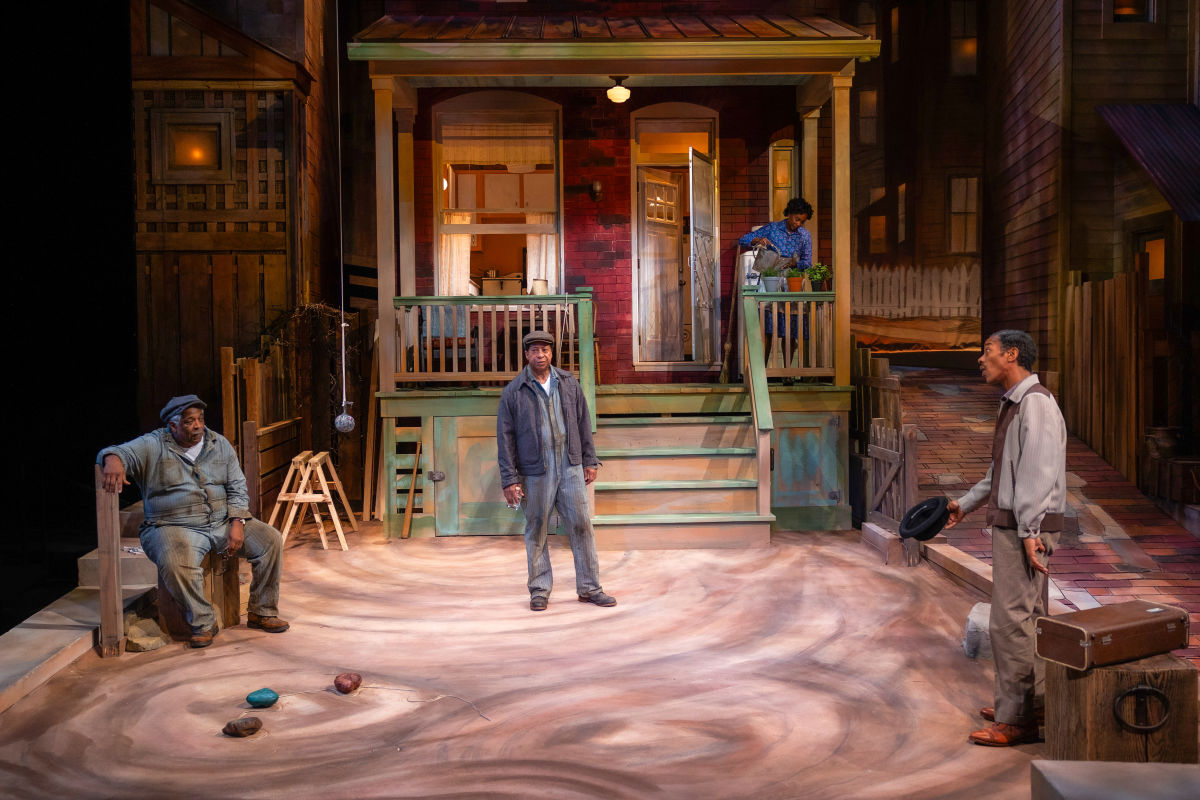
That intimacy—with Wilson, with Pittsburgh, with the texture of Black American life—shows up throughout the production: in the way the Maxsons’ house, with its color scheme and architecture, would look right at home in the City of Steel; in how the actors—long-standing Alley Theatre members David Rainey and Michelle Elaine as Troy and Rose, and Broadway’s Aramie Payton as their son Cory—pointedly embody a sort of East Coast blue-collar indignation that reveals a layer of leathery love under the surface. “These plays have such a rhythm,” Morris says. “These characters have their own way, their own style, their own essence of being. And that’s what we were looking for.” The effortless shift between humor and drama, the musicality of each character’s dialogue, and the way each performer moves through the set all contribute to that sense of rhythm.
Though Fences is now 41 years old and set nearly 70 years ago, universal truths persist, like familial love, hardship, and forgiveness. “It’s a story of a family that loves so hard, and it shows,” Morris says. Parallels can also be drawn between Cory Maxson and Wilson’s youth, rooting the story in reality. Both had brief military stints at a young age, and both buried their fathers in the mid-1960s.
Morris believes young audiences can still find value in the story. “The play…talks about family, deals with unconditional love, deals with the dynamics of father and son, of husband and wife, siblings, and the community,” she says. “That’s our world every day, each and every one of us… These may be African-American people that are up there telling this story, but they’re familiar things that we all witness.”
Image: Alley Theatre
Moments throughout the show make that familial love land: Rose touching Troy from behind as his face is full of anguish, or her stopping herself from walking out of the house while Troy gives Cory a life lesson; Cory’s indignant attitude toward his father and his playful energy with his mother; Troy’s sternness with his son and his effortless humor with his wife. They’re the kind of details that can be written on the page, but only onstage does the full weight of them take hold.
Great theater is a collaborative effort, and Morris’s production proves it. When the director’s attention to detail aligns with the playwright’s vision, the actors are attuned to the director’s intentions, and the set accentuates the rhythm and energy of the performers, the result extends beyond the stage. It drifts into the mind long after the curtain falls, reminding viewers of people they know and creating a vivid, lingering fictional reality.
Wilson’s story about love, tragedy, and the fences we put up to keep people out—or in—holds an intimacy that transcends its setting. As Morris puts it: “We want to be loved. We want to forgive. We want to move forward. We want the best for each and every one of us that we are surrounded by. And that’s all this is.”
Stewardship
02/10/2026
By
Meredith Nudo
Bayougraphy
12/23/2024
By
Holly Beretto
Yes, And…
03/03/2026
By
Emily Hynds
On the Move
01/29/2026
By
Brooke A. Lewis
• Read the full Houstonia article to learn about Eileen Morris's friendship with August Wilson and what shaped this production.
• Visit the Alley Theatre's website to find ticket options and showtimes before May 10.
• If you've never seen or read Fences, the article gives a helpful feel for the story and why it still resonates.
• Look into Ensemble Theatre, Houston's only Black theater company, if you want to see more of Eileen Morris's work.
• Share this article with a friend or family member who loves theater, history, or Houston's arts community.