"Houston doesn't always get credit for the writers it produced. This article makes a case that Barthelme's restless, surface-obsessed style wasn't born in Manhattan — it was refined in a city that bulldozed its past to build freeways and called it progress. If you're curious about Houston's place in American culture and literature, this is a satisfying read."
Donald Barthelme published 129 stories in The New Yorker and became known for sharp Manhattan wit — but he was a Houston native. He grew up in a modernist home designed by his architect father, dropped out of the University of Houston, and worked at The Houston Post before finding fame in New York. This article explores how Houston shaped the sensibility behind one of America's most celebrated fiction writers of the 1970s and '80s.
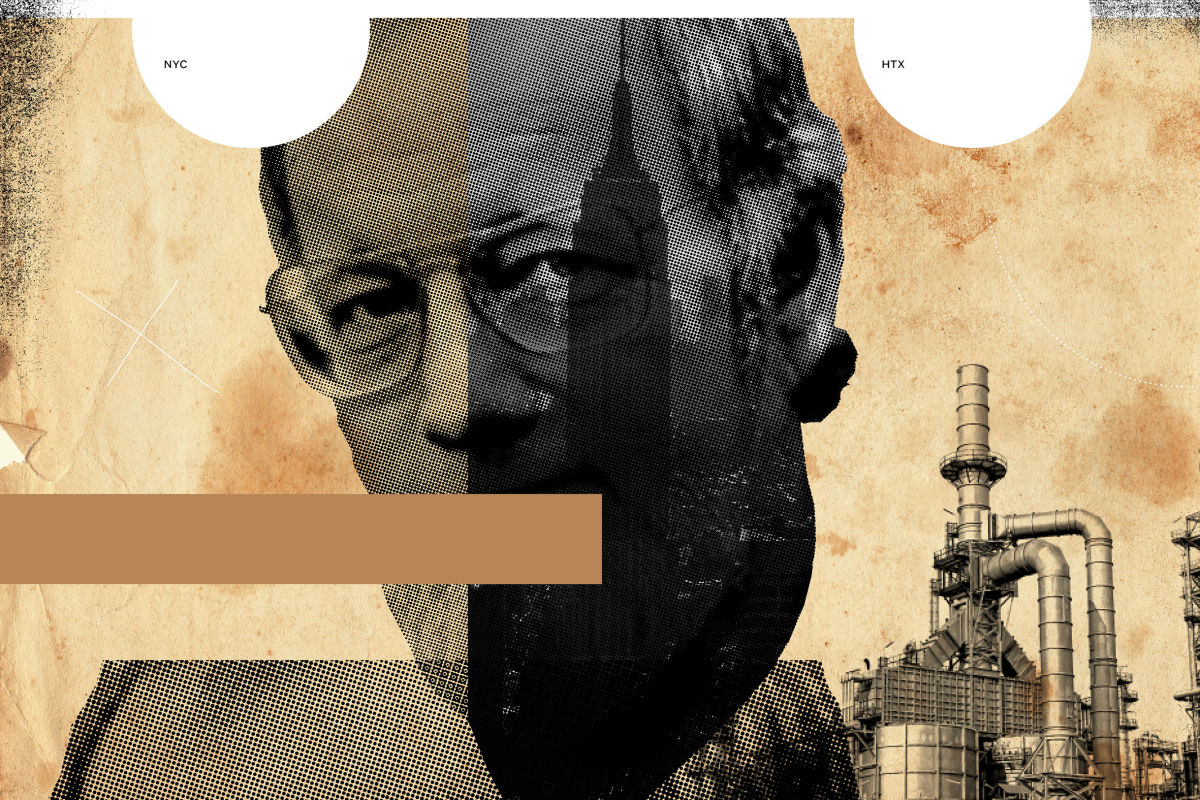
Donald Barthelme was the image of a New York writer. He published in The New Yorker, wrote about lofts, cocktails, and conceptual art, and perfected a tone of urban irony that seemed inseparable from Manhattan itself. But that sensibility was born at about as much of a cultural distance from New York’s most famous island as there was.
Manhattan has long cultivated that illusion of centrality—an illusion perhaps nowhere better encapsulated than in one of the great New Yorker covers of all time—and indeed, one of the great magazine covers of all time. I’m thinking of Saul Steinberg’s “View of the World from 9th Avenue,” which adorned the March 29, 1976, issue of the magazine. From its satirical vantage, the vast expanse beyond the Hudson River is reduced to a barren lunar surface; the rest of the country appears roughly the size of four Manhattan blocks. The joke takes pleasure in a Manhattanite’s tendency to confuse their parochial island and its teapot tempests for the world itself.
Steinberg, an outsider who made Manhattan legible to itself, understood how provincial cosmopolitanism could be. Through The New Yorker, he became emblematic of a national persona that often imagined itself universal. In this dynamic—the outsider who becomes the face of the metropolis—Steinberg found his closest literary analog in Barthelme himself, who would come to perform a similar trick in prose: making Manhattan feel both definitive and faintly absurd at once.
Like Steinberg, Barthelme—novelist, short story writer, and mentor to countless young writers—came to epitomize the droll urbanity of Manhattan in the ’70s and ’80s, its aloof decadence and dry wit. As Scott Bradfield wrote for the same magazine in 1993, Barthelme “fit into The New Yorker’s fictional timeline quite neatly…Manhattan was the perfect subject for Barthelme’s comic method.” Between 1963 and the late 1980s, he placed 129 stories in the magazine.
Barthelme’s Manhattan was not Uptown elegance but Downtown irony: editors nursing scotches, IBM Selectric typewriters clacking through the night in cramped bedsits, loft parties in SoHo before the neighborhood was merely south of Houston—Houston Street, that is, pronounced “House-ton,” and a different place in more ways than one than Don’s city on the bayou. New York’s clutter—overflowing ashtrays, cocktail napkins, half-ironic talk of “modernity”—fueled the fragments that became his stories.
Consider his short story “The Balloon” (1966), in which a massive balloon mysteriously expands over Manhattan, becoming a civic event and conceptual artwork at once. Or, City Life (1970), the novella whose vignettes render the normalized chaos of skyscraper offices into a distributed installation. No doubt, New York gave Barthelme material.
But “Beau”—as Barthelme’s friends knew him—was not, as the expression goes, to the manner born. As his friend, the author Thomas Pynchon memorably put it, behind Barthelme’s “slick city-sophisticate disguise” there still lingered “this good old Dairy Queen regular…harboring the mischievous daydreams of a Texas rounder.” Houston, his hometown, remained a source of both attraction and discomfort—“in Texas-size quantities.”
The truth is that Barthelme’s fictional impulses were polished—and found their perfect setting—in New York, but their “highly seasoned” DNA is all Houston.
In 1975, Barthelme published his Freudian satirical novel The Dead Father. He was well-suited to the topic, having lived a Freudian satire of his own. His father, Donald Sr., was a famous modernist architect and professor at the University of Houston. The younger Don dropped out of that same university after a desultory try and went to work as a journalist for The Houston Post. As he later told The Paris Review, “We were enveloped in modernism.” His father, who had designed their home, ensured that. “The house we lived in…was modern and the furniture was modern and the pictures were modern and the books were modern,” he recalled.
After a stint in the army during the Korean War and several years working as a journalist at The Houston Post, Barthelme began drifting toward the literary world that would eventually lead him to New York in the early 1960s. The move was not unusual—midcentury Manhattan still functioned as the gravitational center of American letters—but for Barthelme it meant translating a sensibility formed in Houston’s uneasy modernity into a language legible to the East Coast establishment.
Even as a young man, Barthelme was developing a creative consciousness in a strange place, one where high-concept modernism flourished within a city still powerfully, even confrontationally, regional. He learned early to value “the new” above all else. That’s a deceptively simple orientation. On the one hand, it is the credo of the modernist movement—Ezra Pound’s injunction to “make it new.” On the other, an ethos of novelty über alles opens itself to charges of indifference to tradition and history: the very kryptonite of highbrow sophistication.
That paradox mirrors Houston in the postwar decades: a city so desperate to modernize, build, grow, and advance that it often obliterated its own past. Whole blocks of early-twentieth-century bungalows were bulldozed for freeways. Concrete was poured faster than streets could be named. Modernist towers rose beside bayous still half-wild, while developers advertised “Tomorrow’s Neighborhoods, Today.” The result was a city that looked as though it had skipped a century of history—an architectural collage as strange and restless as Barthelme’s stories.
Both Houston and Barthelme’s prose hummed with excitement about the future—and a concomitant indifference to the past—that achieved surreal and absurdist scope. Beau Barthelme never donned arch Henry Ford drag to pronounce history bunk. He didn’t have to. What he liked were surfaces and things, especially the glossy ones. As Pynchon called it, “Barthelismo.”
He liked things bright, shiny, moldable: the characteristics of plastic made with petrochemicals refined right there in Houston.
If New York was the marketplace for his fiction, Houston was its refinery, and plastic was a perfect metaphor. It is an oil-born substance that can take any shape—polished and disposable, brilliant and toxic. It is infinitely reproducible, molded under pressure, hardened into forms that look permanent but are anything but. Houston, capital of the American petrochemical industry, refines the very materials that made late-twentieth-century modernity feel synthetic. And Barthelme’s sentences behave the same way—synthetic, smooth, resistant to decay because they are not really made of organic material to begin with. They gleam. They flex. They resist sentimentality.
In “The Balloon,” for instance, the titular object itself resists symbolic depth, existing instead as a surface to be interpreted and reinterpreted at will. “There was no getting around the fact that the balloon was there,” the narrator notes, flatly, as if describing a piece of infrastructure. Elsewhere, Barthelme’s prose moves with the same manufactured smoothness: “Fragments are the only forms I trust,” he writes in City Life, a line that reads less like confession than like a Houstonian design principle.
Houston became, in its own way, a node in the broader postmodern turn—a place where fiction’s emerging obsession with surfaces and plastic forms found a material analog. Andy Warhol, one of plastic’s most famous admirers, once said he wanted to be plastic: a condition already well into beta testing in Houston. It was a place where the drive, as Ezra Pound said, to make it new met a willingness to tear down what came before, where surfaces—glass towers, vinyl seats, neon signage—were treated less as masks than as just-the-facts-ma’am. Barthelme’s fiction registers that same logic. His stories don’t dig beneath appearances so much as rearrange them, treating the world as something already processed, already synthetic.
Barthelme’s unique contribution to the national zeitgeist was rooted in that contradictory city: modernist yet regional; synthetic yet still, somehow, humid; ambitious yet unserious. His fiction did not merely reflect Manhattan’s self-awareness. It carried within it the petrochemical energy of a city forever under construction.
Barthelme’s relationship to Houston was not merely formative; it was ongoing. Beginning in the 1970s, he returned regularly to teach creative writing at the University of Houston, eventually moving back full-time in 1983 to direct its now-prestigious Creative Writing Program. The city he had once left became, again, a site of literary production and influence. He died here in 1989, closing a career that had always, in some sense, been bookended by Houston.
When Steinberg drew his map of Manhattan looking west, he meant it as a joke about parochial vision. Barthelme, in his way, redrew that map from the opposite direction—from the swampy flatlands of a city that few New Yorkers could find in their own atlas. He showed that just like architecture, satire needs foundations somewhere real. From that vantage, the little balloon over Manhattan becomes only one bright piece of a larger sky.
NEW RESTAURANTS
04/08/2026
By
Brittany Britto Garley and Sofia Gonzalez
Oscars of Food
03/31/2026
By
Sofia Gonzalez
Closing time
03/31/2026
By
Sofia Gonzalez
No Filter
03/26/2026
By
Brittany Britto Garley and Houstonia Staff
Spring Soirée
03/25/2026
By
Brittany Britto Garley
Mudbugs
03/20/2026
By
Brittany Britto Garley and Sofia Gonzalez
On The Town
05/30/2022
By
Chris Gray
Literary Houston
5:00am
By
Travis Alexander
Houston Collects
04/06/2026
By
Meredith Nudo
Spring Bucket List
03/20/2026
Edited by
Erica Cheng
By
Houstonia Staff
Bayougraphy
03/19/2026
By
Sofia Gonzalez
Full of Grace
03/19/2026
By
Layne Van Vranken
Literary Houston
5:00am
By
Travis Alexander
On the Ice
04/08/2026
By
Erica Cheng
Oral History
04/02/2026
By
Brittany Britto Garley
Bayougraphy
04/01/2026
By
Erica Cheng
Still Growing
03/27/2026
By
Molly Glentzer
Town Crier
03/24/2026
By
Emily Hynds
Reality Reckoning
02/20/2026
By
Brittany Britto Garley
Cowboy Couture
02/19/2026
By
Erica Cheng
Self-Care
01/09/2026
By
Uvie Bikomo, Brittany Britto Garley, and Houstonia Staff
Season’s Readings
12/18/2025
By
Holly Beretto
Touch of Gray
12/17/2025
By
Meredith Nudo
Closet Crush
12/16/2025
By
Layne Van Vranken
Touchdown
01/22/2026
By
Sofia Gonzalez and Daniel Renfrow
Dry January
01/08/2026
By
Brittany Britto Garley and Sofia Gonzalez
On the Dance Floor
12/30/2025
By
Brooke A. Lewis
Jazzin’ it up
12/03/2025
By
Sofia Gonzalez
Holiday cheer
12/02/2025
By
Sofia Gonzalez
Let’s Go, Ghouls
10/27/2025
By
Sofia Gonzalez
Bring Your A-Game
04/03/2026
By
Brittany Britto Garley
Bayougraphy
04/01/2026
By
Erica Cheng
Where to Stay
03/23/2026
By
Sofia Gonzalez and Houstonia Staff
Get Outta Town!
03/12/2026
By
Gabi De la Rosa
West Texas Insider
03/09/2026
By
Brittany Britto Garley
Spring in Houston
03/04/2026
By
Claire Sewell
Oral History
04/02/2026
By
Brittany Britto Garley
Best of the City
03/24/2026
By
Houstonia Staff
Self-Care
01/09/2026
By
Uvie Bikomo, Brittany Britto Garley, and Houstonia Staff
Green Miles
01/05/2026
By
Saba Khonsari
Time to relax
12/01/2025
By
Gabi De la Rosa
Houston in Formation
11/24/2025
By
Brittany Britto Garley
Still Growing
03/27/2026
By
Molly Glentzer
Property Watch
03/26/2026
By
Diane Cowen
The Dirt
03/25/2026
By
Meredith Nudo
Houston in Bloom
03/23/2026
By
Molly Glentzer
Home & Design
03/16/2026
By
Diane Cowen
City Shift
03/16/2026
By
Sofia Gonzalez and Brittany Britto Garley