"When residents lead and communities are trusted with resources, good things happen. Research shows that neighborhoods with strong civic networks recover faster from disasters, attract more investment, and build the kind of trust that reduces isolation and violence. LISC Houston's programs are built on that idea — that local people, given the right tools and a little funding, can solve local problems."
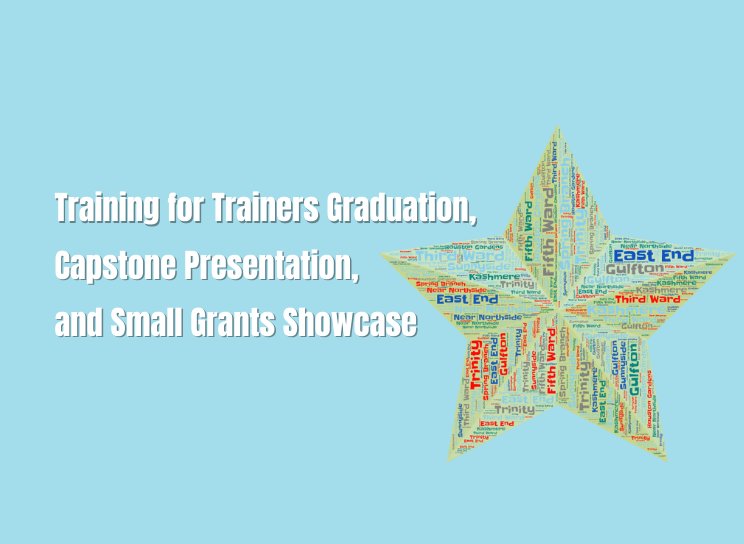
On February 7, 2026, LISC Houston held its second annual Training for Trainers (T4T) Graduation, Capstone Presentation, and Small Grants Showcase at Giant Texas Distillery. Nearly 50 leaders from government, nonprofits, civic clubs, Super Neighborhoods, and resident groups came together to explore what happens when communities invest in local leadership and trust residents with resources. The event highlighted leadership development and small-scale funding as tools for strengthening Houston neighborhoods.
Block by Block: How Civic Leadership and Flexible Capital Are Strengthening Houston Neighborhoods
On Saturday, February 7, 2026, LISC Houston hosted its second annual Training for Trainers (T4T) Graduation, Capstone Presentation, and Small Grants Showcase at Giant Texas Distillery.
Nearly 50 leaders from government, nonprofit organizations, civic clubs, Super Neighborhoods, and resident groups gathered to examine a practical question: what happens when you invest directly in local leadership and trust residents with resources?
The event highlighted two complementary strategies: how leadership development and small-scale catalytic funding strengthen neighborhood-level systems and advance opportunities.Why Civic Leadership Matters
Communities with strong civic infrastructure outperform those without it. Decades of research on social capital, most notably by Harvard sociologist Robert Putnam, demonstrate that communities with dense networks of trust and participation experience stronger economic outcomes and greater resilience. Brookings Metro Fellow Hanna Love has further advanced this conversation through her work on “social infrastructure,” the neighborhood institutions and trusted relationships that anchor communities and translate policy into lived progress.
To deepen this conversation, Hanna will join LISC Houston as keynote speaker followed by leading an interactive workshop at Envision: State of Communities on March 18. Register For Envision 2026!
The National Civic League and Urban Institute similarly find that cities with higher civic participation rates recover more quickly from crises and demonstrate stronger public trust.
Communities with active resident leadership recover faster after disasters, secure investment more effectively, and build the social cohesion that reduces violence and isolation. Most importantly, they create their own solutions.
That is the “so what” behind LISC Houston’s Training for Trainers (T4T) program.
Since 2016, more than 200 Houston residents have completed T4T. The program equips leaders with skills in facilitation, project design, stakeholder engagement, and neighborhood organizing while building cross-neighborhood networks that expand collective capacity.
The 2025 cohort included 16 leaders from Denver Harbor, Magnolia Park, Near Northside, and Sunnyside. Each neighborhood-based team implemented a capstone project addressing a lived, immediate challenge.The Architecture of Local Power in Action
In Denver Harbor, the team launched Celebrating Denver Harbor: One Block at a Time, combining pop-up engagement, business visibility, murals, façade improvements, and beautification efforts to reinforce neighborhood pride. Research from the Urban Institute and Project for Public Spaces shows that visible public space activation increases foot traffic and improves perceptions of safety, two factors closely associated with local economic vitality.
In Magnolia Park, the team introduced Nuestras Casas, a culturally rooted housing preservation initiative centered on protecting generational homes, “Cuida la Casa de Abuela.” In Houston, heirs’ property and deferred maintenance are quiet drivers of displacement. Research from the Federal Reserve Bank of Atlanta highlights how heirs’ property instability contributes to wealth erosion and involuntary displacement, particularly in communities of color. Magnolia Park’s prevention-oriented approach, coordinating volunteers, partnerships, and an online repair platform, demonstrates anti-displacement strategy in practice.
In Near Northside, Clean & Green mobilized more than 60 residents to address illegal dumping at Moody Park while training neighbors to use the City’s 311 system. Environmental neglect is not cosmetic. Urban policy research links illegal dumping and infrastructure disrepair to flooding vulnerability and adverse health outcomes. Resident reporting systems are correlated with improved municipal responsiveness and infrastructure maintenance.
In Sunnyside, Engage Sunnyside addressed declining participation at Super Neighborhood meetings. By introducing outreach materials, food incentives, and virtual Zoom access, reportedly the first in that neighborhood, attendance barriers began to fall. Research from the Knight Foundation and Pew Research Center confirms that lowering participation barriers, including transportation and scheduling constraints, significantly increases civic engagement.
These projects may not make national headlines. But they reflect what Brookings scholars describe as bottom-up civic capacity: the essential layer of democracy that determines whether policy translates into neighborhood-level progress.
Small Grants: Flexible Capital at the Neighborhood Level
Leadership capacity must be paired with capital. Urban Institute research on community development finance shows that small-scale catalytic dollars can generate outsized neighborhood impact when aligned with strong local leadership networks.
Launched in 2015, LISC Houston’s Small Grants Program provides flexible funding to resident-led initiatives. Unlike traditional funding streams, small grants move quickly, carry minimal administrative burden, and allow residents to define priorities.
In 2025, 10 funded neighborhoods included Magnolia Park, Spring Branch, Greater Third Ward, Northline, Near Northside, Sunnyside, Kashmere/Trinity/Houston Gardens, East End, Fifth Ward, and Gulfton. The projects addressed education, disaster resilience, creative placemaking, safety, youth engagement, and civic participation.A Small Sample of Projects
La Escuelita de Magnolia Park — A free summer cultural education program for high school students focused on history, identity, and civic awareness. Research from the Learning Policy Institute finds that culturally relevant education models improve engagement and long-term academic persistence.Emerging Civic Leaders Gala (Greater Third Ward) — Connecting youth with elected officials. Studies from CIRCLE at Tufts University show that early civic exposure significantly increases lifetime voting and leadership participation.Moody Park Turns 100 (Near Northside) — A centennial celebration drawing over 1,000 attendees and 28 vendors, reinforcing parks as economic and social anchors. Public space activation is consistently associated with stronger neighborhood cohesion and perceived safety.Sunnyside Legacy Mural — A community-driven mural engaging more than 100 residents. The National Endowment for the Arts documents how participatory arts initiatives strengthen neighborhood attachment and social trust.Destined for Resilience (Kashmere/Trinity/Houston Gardens) — Hurricane preparedness workshops. FEMA research shows that communities with pre-disaster education recover more quickly and experience less displacement.Papel Picado Art Workshops (Gulfton) — Four workshops engaging 96 residents and culminating in a permanent installation. Participatory arts programming strengthens cross-cultural connection and neighborhood identity.
Click here to read more 2025 projects.
These grants are modest in size. But they function as catalytic capital, unlocking volunteer energy, increasing participation, and reinforcing neighborhood systems.A Practical Model for Neighborhood Strength
What was most powerful about the event was not only the individual projects, but the network effect. Leaders from Denver Harbor connected with organizers from Near Northside. Civic club members from Near Northside exchanged ideas with leaders from Magnolia Park. Park advocates met muralists. Civic trainers connected with food justice organizers.
These cross-neighborhood connections compound over time. Network theory research shows that communities with strong horizontal ties are more adaptable, innovative, and capable of scaling solutions.
And this work does not stop at the showcase.
On March 18 at Envision: State of Communities – Strength in Strategy, Houston leaders will continue this conversation examining how civic infrastructure, flexible capital, and neighborhood-led leadership form the foundation of equitable economic mobility. As Hanna explores the national research behind social infrastructure and economic resilience, and as practitioners unpack real-world applications in her workshop, the through-line becomes clear: neighborhood strength is not accidental. It is designed, invested in, and sustained.
If Houston is serious about long-term mobility, resilience, and inclusive growth, the strategy is straightforward: invest in local leadership, trust residents with resources, and build durable neighborhood capacity block by block.
Register HERE For Envision 2026!