Article
What is Public Deliberation? A Guide to Better Community Decisions
Why this matters
Unlike regular political debates where people talk past each other, deliberation helps people learn about issues, listen to different viewpoints, and find common ground. Trained facilitators guide citizens through structured conversations where they can discover shared values, consider tough trade-offs, and make decisions together. This approach goes beyond just dialogue by asking participants to weigh the real costs and benefits of different choices.
Overview
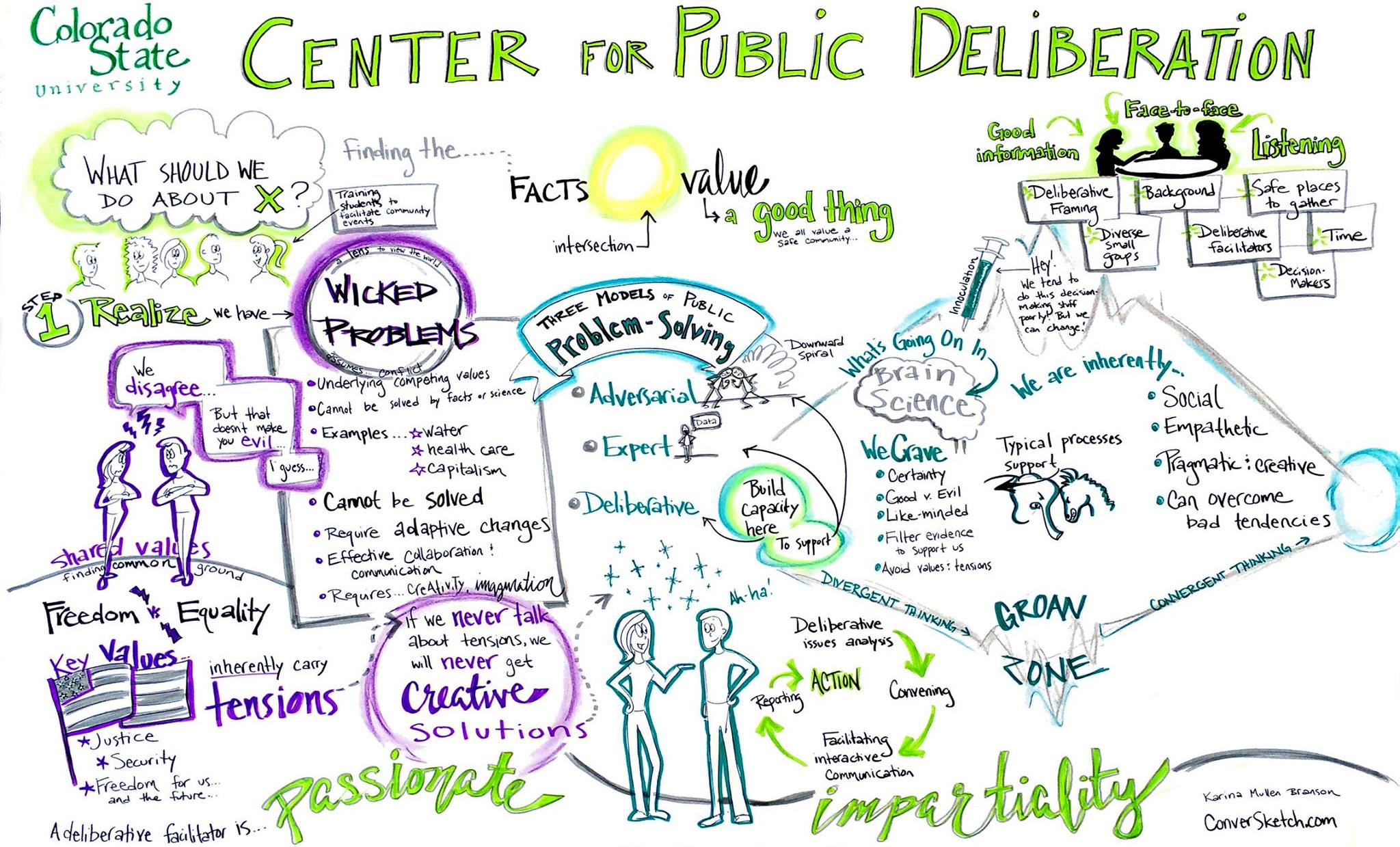
Public deliberation is a way for everyday citizens to come together and solve community problems through thoughtful discussion. Unlike regular political debates where people talk past each other, deliberation helps people learn about issues, listen to different viewpoints, and find common ground. Trained facilitators guide citizens through structured conversations where they can discover shared values, consider tough trade-offs, and make decisions together. This approach goes beyond just dialogue by asking participants to weigh the real costs and benefits of different choices. The Center for Public Deliberation at Colorado State University explains that this method is the cornerstone of healthy democracy, helping people with different interests work together on challenging problems. Rather than simplifying complex issues or attacking opponents, deliberation embraces complexity and seeks balanced solutions. It connects back to ancient Greek and Roman traditions of civic engagement and represents a more thoughtful alternative to today's polarized political climate.
{"full_text":"What is Deliberation? - Center for Public Deliberation \n\n What is public deliberation? \n\n It's about considering all the possibilities, before assuming you have all the answers.
\n\nA Way of Decision Making\n\nDeliberation is an approach to politics in which citizens, not just experts or politicians, are deeply involved in community problem solving and public decision making. Working with trained facilitators who utilize a variety of deliberative techniques, citizens come together to:\n\nLearn about the issue\n\nTalk with, not past, each other\n\nConsider diverse points of view\n\nDiscover key tensions and values\n\nSpark new ideas\n\nMake decisions\n\nNot Politics as Usual\n\nToo often, bad communication is seemingly rewarded in our political system.
\n\nCampaigns frame tough questions as if there are obvious choices (high taxes v. low taxes or good roads vs. bad roads), rather than the tough choices and value dilemmas inherent to public policy decisions (high taxes and good roads v.
low taxes and bad roads). For democracy to thrive, decision-makers need to confront the complexity of issues and attempt to balance competing values, not distract from them. \n\nThe practice of deliberation is the cornerstone of democracy and community politics.
Deliberation connects people, even those with conflicting interests, in a way that allows them to make decisions and act in regard to problems or challenging circumstances. \n\nA Communication Practice\n\nDeliberative democracy is also of particular interest to communication scholars. Indeed, the art of deliberation in many ways represents the traditional heart of a rhetorical education spanning back to the classical Greek and Roman societies.
Deliberation is far removed from the manipulative “non-contradictory” argumentation that typifies much contemporary political debate. Rather, an ideal rhetorical perspective seeks out opposing perspectives, understands the importance of factual information, considers the inherent value dilemmas in all public controversies, and relies on structured discussion and debate to help achieve the critical goal of reasoned judgment.
Deliberation should also be differentiated from dialogue.
Looking for programs in Houston?
Feedback Loop
Community members help keep this accurate